NetSuite Integration: Cutting Double Entry with Automation
If your team is re-entering the same information NetSuite already holds, your website isn't finished yet.
We covered this problem from the Sage 200 side in our last post, using BBP as the example. NetSuite tends to sit behind a different kind of business: subscriptions, memberships, applications, bookings. Anything with an ongoing customer relationship rather than a single transaction. The fix, though, is the same principle. Connect the two systems properly, and stop treating your website as separate from the business it's meant to run.
Signs you need a NetSuite integration
A few things tend to give it away:
Someone on your team copies customer details from a web form into NetSuite by hand
Applications, sign-ups, or bookings sit in an inbox before anyone actions them
Account information looks different depending on whether a customer checks the website or calls your team
Approvals, credit checks, or provisioning happen manually because nothing triggers them automatically
Any of that sound familiar? That's not a staffing problem. It's a missing integration.
What changes when your website actually talks to NetSuite
Area | Without integration | With integration |
|---|---|---|
Customer data | Entered twice, drifts out of sync | Created once, synced automatically |
Applications and sign-ups | Manually reviewed and actioned | Written directly into NetSuite workflows |
Account management | Support handles changes by request | Customers self-serve, NetSuite stays the record |
Operational workflows | Approvals and checks run manually | Triggered automatically from website activity |
The pattern across all four. NetSuite stops being a system your team updates about the website, and starts being the system the website runs on.
Case study: how Hooplr connected their platform to NetSuite
Hooplr, formerly Cyclehoop Rentals, provides secure, bookable cycle parking across UK towns and cities, and now has more than 7,000 bookable bikehangars in operation. As the business rebranded and scaled, it needed more than a new look. It needed a customer application, account management, and operational workflows that worked together as one system, not several disconnected ones.
We delivered a complete rebrand alongside a new website, a bespoke customer application, and a NetSuite integration connecting every touchpoint. Residents can register interest, apply for a space, and manage their account through a self-service interface, with every action syncing directly with NetSuite behind the scenes.
That integration removed duplicate processes across the business, cut manual administration, and gave the Hooplr team a single, trustworthy source of truth for customer and operational data. The platform also launched fully bilingual, in English and Welsh, supporting deployments across Wales and public sector accessibility expectations, itself a workflow that depends on clean, well-structured data flowing correctly between the website and NetSuite.
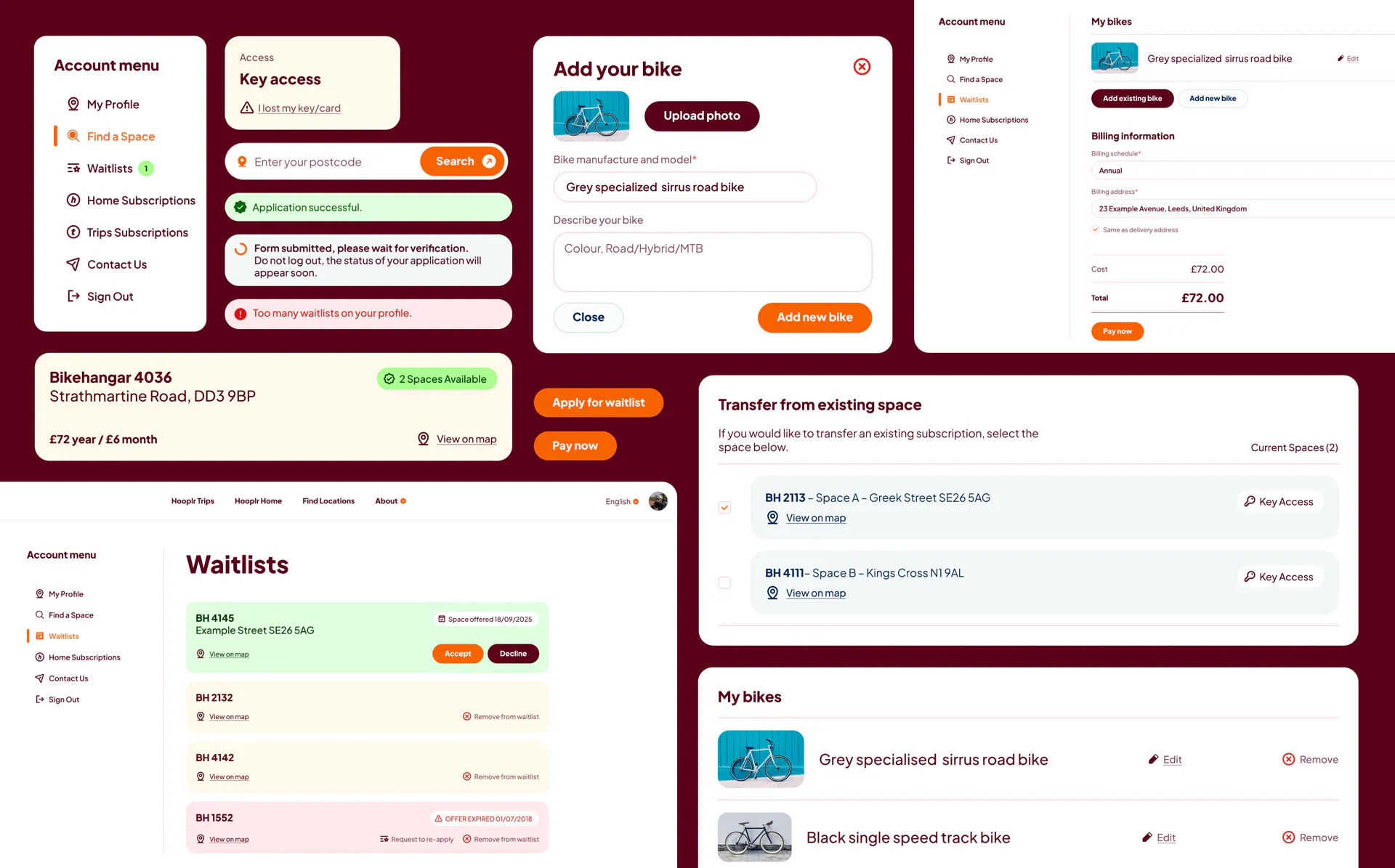
The results since launch:
More than 7,000 bookable bikehangars supported
More than 1,000 sign-ups at launch
Two fully supported languages across every page and application journey
100/100 SEO score and 98/100 performance score at launch
The technical options: SuiteTalk, RESTlets, or SuiteQL
Once you've decided to integrate, there's a second decision underneath it: which part of NetSuite's toolkit actually does the work.
SuiteTalk
NetSuite's standard web services API, available as SOAP or REST. It's built for straightforward record operations, creating, updating, and retrieving standard NetSuite records, and it's the usual starting point for most integrations.
RESTlets
Custom-scripted endpoints you build inside NetSuite using SuiteScript. Rather than working within SuiteTalk's generic structure, a RESTlet exposes exactly the logic and data your integration needs. They're the better fit when your workflow doesn't map cleanly onto standard record operations. Think multi-step applications, custom approval logic, or anything specific to how your business actually runs.
SuiteQL
SQL-like query language for reading data out of NetSuite. It's particularly useful when you need to pull larger or more complex datasets than a standard API call handles efficiently, such as reporting or reconciliation work.
Most real integrations end up using more than one: SuiteTalk or RESTlets to write data in, SuiteQL to read it back out efficiently.
Connector or custom build? A quick way to decide
Ask yourself what your website actually does day to day.
If it's mainly a storefront
Customers browse, order, and check out. A pre-built connector syncing orders and inventory is often enough. It's faster to set up and built for exactly that use case.
If it's an application, account, or booking platform
Like Hooplr, a custom API integration is worth the extra investment. Off-the-shelf connectors are built around orders, not applications, approvals, or subscription management, so they tend to break down once your workflows get more specific than "buy this, ship that."
Before you commit, ask these questions
Who holds the authoritative record once this is live: NetSuite, or the website? (It should be NetSuite.)
What happens if a sync fails halfway through? Will anyone know?
Does the integration need to handle workflows, like approvals or provisioning, or just data?
Will this still work when volume doubles, or does it need rebuilding?
If you can't answer all four confidently, that's worth resolving before development starts, not after.
Running on NetSuite and thinking about integrating it with your website or customer platform? Get in touch or explore our API and integrations services.